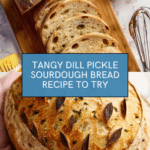
Dill Pickle Sourdough Bread Recipe
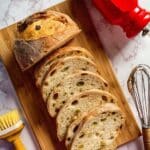
This Dill Pickle Sourdough Bread recipe combines tangy dill pickles and pickle juice with a classic sourdough base to create a flavorful, crusty loaf with a moist crumb. The inclusion of dark rye flour adds depth and complexity, while the methodical stretch and folds and cold proofing develop a beautiful texture and crust. Perfect for serving sliced with butter or as a sandwich bread, this loaf brings a delightful pickle twist to traditional sourdough baking.
- Prep Time: 30 minutes
- Cook Time: 45 minutes
- Total Time: 4 hours 15 minutes plus overnight cold proof
- Yield: 1 medium loaf (about 800-900 grams) 1x
- Category: Bread
- Method: Baking
- Cuisine: American
- Diet: Vegetarian
Ingredients
Scale
Liquid and Starter
- 180 g warm water
- 150 g pickle juice
- 100 g active sourdough starter
Flours and Salt
- 400 g bread flour
- 100 g dark rye flour
- 5 g fine sea salt
Inclusions
- 150 g dill pickles, finely diced
Other
- Flour for dusting work surfaces (preferably rice flour for final dusting)
Instructions
- Make the dough: In a large bowl, combine 180g warm water and 150g pickle juice. Whisk in 100g active sourdough starter until mostly combined. Add 400g bread flour and 100g dark rye flour, mixing until a shaggy dough forms. Knead with your hands to incorporate all flour. Sprinkle 5g fine sea salt over the dough.
- First rest: Cover the bowl and set aside for 45-60 minutes to allow the flour to hydrate.
- First stretch and fold: Using damp hands, grab the dough, stretch it until the flap is long enough to fold over itself, fold, rotate the bowl 90 degrees, and repeat 4 times. Cover and rest for 30 minutes.
- Prepare pickles: Dice 150g dill pickles finely and pat dry with paper towel to reduce excess moisture.
- Add pickles and subsequent stretch and folds: Add the diced pickles to the dough and perform the stretch and fold to incorporate them. Rest for 30 minutes, then perform 2 more sets of stretch and folds, totaling 4 sets. If pickles make dough wet and sticky, generously flour work surface and dough and gently knead to bring dough together.
- Bulk ferment: After the final stretch and fold, cover the bowl and allow the dough to bulk ferment in a warm place for 2 hours to develop flavor and gluten.
- Shape the dough: Lightly flour a work surface and turn the dough out with the smooth side down (sticky side up). Fold dough sides into the middle, then roll tightly from the bottom to form a batard or tuck ends under for a boule. Let rest covered for 20 minutes.
- Increase surface tension: Place your hands underneath the dough, use pinkies to apply gentle pressure, and drag the dough along the work surface to increase surface tension without tearing the dough.
- Proof in banneton: Dust top with rice flour, use a bench scraper to flip dough seam side up into a banneton. Cover and proof at room temperature for 2 hours.
- Cold proof: Cover the banneton with a reusable plastic bag and refrigerate overnight (or for the proving period) to slow fermentation and develop flavor.
- Preheat oven: Place a Dutch oven, cloche, or baking dish in the oven and preheat to 450°F (232°C).
- Prepare for baking: Remove dough from fridge, invert banneton onto parchment paper. Score dough with a lame or sharp knife—typically a deep curved slash works well for inclusions.
- Bake covered: Carefully remove the preheated Dutch oven, use parchment paper as a sling to transfer dough into it. Cover and bake at 450°F for 30 minutes.
- Bake uncovered: Remove the lid and bake uncovered at 450°F for an additional 10-15 minutes until crust is a rich caramel brown and internal temperature reaches 205-210°F.
- Cool: Remove loaf from Dutch oven and transfer to a wire rack. Cool completely for at least 2 hours before slicing to set crumb and texture.
Notes
- Make sure your sourdough starter is active and bubbly before beginning the recipe for best rise.
- Dicing the pickles finely and drying them helps prevent excess moisture from weakening the dough.
- Stretch and folds help develop gluten and evenly distribute inclusions without overworking the dough.
- Cold proofing enhances flavor complexity and improves dough handling.
- Using a Dutch oven traps steam for a crispy crust and better oven spring.
- Allow the bread to cool fully to avoid gummy texture in the crumb.
Keywords: Dill Pickle Sourdough Bread, sourdough bread, pickled bread, homemade bread, rye sourdough, fermented bread, crusty bread, artisan bread
Find it online: https://recipeswithmia.com/dill-pickle-sourdough-bread-recipe/